SHOAH ' Twentieth Century Genocide'
Welcome to 'SHOAH'
Note on Terminology: While "Semitic" refers to a language family encompassing various peoples—including Arabs, Assyrians, and Phoenicians—the term "antisemitism" was coined specifically to target Jews. To maintain linguistic precision and avoid ambiguity, this site uses the terms anti-Jewish or anti-Judaism to describe prejudice against Jewish people and faith.
Never Forget
This site is dedicated to all the victims of the Holocaust. It also highlights the profound evil of collaboration, where far too many people sided with their nation’s enemies for ideological reasons or personal gain.
Sadly, every nation that fell under the Nazi yoke—whether through occupation or alliance—had its share of collaborators who brought everlasting shame to their homelands. These individuals ranged from high-ranking civil servants and national police forces to the railwaymen who organised and drove the trains to the death camps in the East. They included civilians who rushed to enrol in Nazi-style organisations and those who helped identify or denounce their Jewish neighbours.
Without the active participation of these citizens, the Nazis would not have had the manpower to carry out the "Final Solution" on such a devastating scale. This site honours the Righteous Among the Nations who risked everything to protect the persecuted, and it condemns those who enabled the Holocaust through their complicity.
Symbols of Hatred
The racial hierarchy of Hitler’s Third Reich served as a chilling parallel to South Africa’s later Apartheid state. Just as Black South Africans were stripped of their rights by those who deemed them inferior, the Nazi regime classified Jews as Untermenschen (subhuman). They were systematically denied the rights of citizenship and purged from the Gemeinschaft (national community).
Jews were barred from virtually every aspect of German life—from professional industries to sports and leisure. They were made to feel unwelcome in their own country before being forcibly removed altogether. The Swastika, adopted as the emblem of National Socialism, evolved into a global symbol of hate, intolerance, and pure evil. Ultimately, the ghettos of Warsaw and Łódź, along with the death camps of Auschwitz, Treblinka, and Sobibor, remain the ultimate symbols of man’s inhumanity to man.
Murder on a Scale Never Seen Before
The world has witnessed many catastrophes, but none can parallel the Holocaust—Hitler’s war against both real and imaginary foes, including millions of men, women, and children he deemed "undeserving of life.
His personal hatred cost the lives of approximately six million European Jews, 200,000 Roma and Sinti, and 187,000 physically and mentally disabled people. His regime also targeted a vast number of perceived "asocials," including homosexuals, nonconformists, and those deemed criminals. This prejudice, coupled with an obsession for Lebensraum (living space), ignited a global war that engulfed the world in flames and claimed over 50 million additional lives.
This site examines Hitler’s rise to power and the Holocaust he initiated. These pages are dedicated to the memory of all who suffered at his hands and the hands of his henchmen. They serve as a potent reminder of what happens when society turns its back on humanity.
"I touch the scar on my left forearm, just below the elbow. I had the tattoo surgically removed. There were so many people who didn't know and so many questions: 'What do those numbers mean?' 'Is that your address?' 'Is that your phone number?' What was I supposed to say—'That was my name for three years and forty-one days?' One day a kind doctor offered to remove it for me. 'This is not charity,' he assured me. 'It is the least I can do as an American Jew. You were there; I was not.'" — Rena Gelissen, Rena's Promise: A Story of Two Sisters in Auschwitz (1996)
The Twisted Mentality of Heinrich Himmler:
As Reichsführer-SS, Chief of the German Police, and Commander of the Replacement Army, Heinrich Himmler was the primary architect of the Holocaust. An ardent supporter of Hitler’s extermination policies, he served as a driving force behind the Nazi killing machine. Himmler famously argued that even children must be murdered without mercy to prevent future retribution, once stating:
"The child in the cradle must be trampled down like a poisonous toad... we are living in an epoch of iron, during which it is necessary to sweep with iron brooms."— Heinrich Himmler, September 1941
Historical Context: While the Jewish people had faced periods of hardship in antiquity, the nature of their persecution changed fundamentally once Christianity became a dominant political force within the Roman Empire. From that era onward, anti-Jewish sentiment became a recurring and institutionalised feature of European life. It is a sobering historical reality that many of those who carried out Hitler’s "Final Solution" were themselves raised within the Christian tradition, often using centuries-old religious prejudices to justify modern racial hatred.
The Christian Church: Promotors of Hate - The Roots of Jewish hatred
Anti-Judaism is a centuries-old phenomenon with deep roots in religious dogma. For nearly two millennia, Jewish people were collectively labelled by Western Christendom as "Christ-killers"—guilty of the ultimate crime: deicide (the killing of a god).
This charge was levelled as early as the late second century. Melito of Sardis, a bishop in Asia Minor, infamously claimed that because Jesus was God, the Jews were responsible for murdering their own Creator. Such rhetoric from the pulpit fostered an enduring culture of Christian intolerance. These "rants" evolved into systemic persecution, sparking numerous pogroms and the mass murder of Jewish communities across Europe.
Without centuries of vitriol being peddled from Christian pulpits, the foundation for modern antisemitism might never have been laid, and the Jewish people might have been spared generations of organised hate.
Hate in Scripture: The Christian Weapon Against the Jews
Scriptural Roots of Prejudice
The roots of this animosity are often traced back to specific interpretations of the New Testament. In the Gospel of John—frequently cited as the most anti-Jewish of the four Gospels—Jesus is depicted as labelling his detractors as children of the devil:
Ye are of your father the devil, and the lusts of your father ye will do... he is a liar, and the father of it. (John 8:44, KJV)
It is a profound historical irony that these words, attributed to a Jewish teacher, were later used to demonise the Jewish people as a whole.
Furthermore, the Gospel of Matthew provides the foundation for what is often called the "Blood Curse." In this account, the Roman governor Pontius Pilate washes his hands of Jesus' death, while the gathered crowd is depicted as accepting eternal responsibility:
Then answered all the people, and said, His blood be on us, and on our children." (Matthew 27:25, KJV)
This specific verse has been used for centuries to justify "collective guilt," providing a theological pretext for the systemic repression, exclusion, and murder of Jewish communities.
A Legacy of Defamation
Throughout the centuries, various Church leaders and theologians issued vitriolic accusations against the Jewish people. These labels were used to dehumanise Jews and isolate them from the rest of society. Some of the most prominent labels included:
- Murderers of the Lord
- Rebels and destroyers of God
- Companions of the Devil
- No better than hogs in their lewd grossness and gluttony
This culture of prejudice was not confined to any single denomination; it permeated many corners of the Christian world. Even among those also targeted by the Nazi regime, such as the Jehovah’s Witnesses, these deep-seated religious biases remained. Rudolf Hoess, the Commandant of Auschwitz, noted the reaction of Witness prisoners to the fate of the Jews:
"Strangely enough, they [the Witnesses] were all convinced it was right that the Jews should now suffer and die, since their forefathers had betrayed Jehovah."— Rudolf Hoess, Commandant of Auschwitz (Memoirs, 1947)
The SS and the ‘Gottgläubig’ Myth
While Heinrich Himmler left the Catholic Church in 1935, he remained gottgläubig (a believer in God). He maintained a deep interest in spiritualism and mysticism, but rejected "organised religion" because he saw the Church as a political rival to the Third Reich. To replace traditional Christianity, Himmler introduced his own SS rituals, such as Midsummer solstice celebrations and the Eheweihe (a secular SS marriage consecration).
However, Himmler’s neo-religious views were not shared by the majority of his men. In fact, many high-ranking Nazis, including Hitler himself, viewed Himmler’s occult interests with private derision, often considering him a "crank.
The statistics of the SS tell a different story than the one of "pagan warriors":
54% were members of Protestant denominations.
24% remained Roman Catholic.
21.9% identified as gottgläubig (non-denominational believers in God).
This means the vast majority of the SS—the units responsible for the machinery of the Holocaust—remained traditional Christians. A notable example is Auschwitz Commandant Rudolf Höss. Though he hid his Catholic leanings to protect his career, he returned to the Church openly while in custody after the war. Ultimately, the Holocaust was not carried out by a new "pagan" army, but by men who largely maintained their ties to the Christian faith.
The Prejudices of Pastor Martin Niemöller
The case of Pastor Martin Niemöller illustrates the deeply embedded nature of religious antisemitism. Though Niemöller eventually became a famous victim of the Nazi regime and a symbol of resistance, he initially promoted anti-Jewish sentiments within his own parish.
Even as he opposed Hitler's interference in the Church, Niemöller continued to preach that the Jewish people were "under a curse" for their role in the crucifixion of Jesus. He frequently characterised Judaism as "dark and sinister," reflecting the traditional theological prejudices that existed long before the Nazis rose to power. His story serves as a stark reminder that even those who resisted the Third Reich's political tyranny were often still influenced by the centuries of religious hate that had paved the way for the Holocaust.
Martin Luther: The Roots of German Antisemitism
Martin Luther, the father of the Protestant Reformation, is often celebrated as a great reformer, but his legacy is deeply stained by virulent bigotry. In his 1543 treatise, On the Jews and Their Lies, Luther outlined a horrific plan for the treatment of Jewish populations that would, centuries later, serve as a chilling blueprint for the Third Reich.
Luther’s recommendations included:
- The destruction of Jewish homes and the burning of their synagogues.
- The confiscation of all Jewish assets and holy books.
- Forcing Jewish people into hard labour or "living in barns like gypsies."
- Their ultimate expulsion from the country.
These were not mere rants; they were policy proposals. Centuries later, Hitler and his followers would point to Luther’s writings to justify their own atrocities, claiming they were simply completing the work that the "great reformer" had started.
Poisoning the Well: The Black Death
In the 14th century, as the Black Death ravaged Europe, terrified populations sought a scapegoat for the catastrophe. Though the plague was a biological disaster, many Christian communities—often incited by rhetoric from the pulpit—turned their fury toward the Jews.
A malicious conspiracy theory spread claiming that Jews were deliberately poisoning public drinking wells to destroy Christendom. This "blood libel" triggered a wave of horrific massacres; across Europe, hundreds of Jewish communities were burned alive or slaughtered in "preventative" attacks. These medieval atrocities established a dangerous precedent: the idea that Jews were a secret, existential threat to the health and safety of the nation
Jozef Tiso: The Priest-President
The case of Jozef Tiso, the President of the Slovak Republic (1939–1945), illustrates the lethal intersection of Church and State. Tiso was a Roman Catholic priest who stripped Slovakian Jews of their citizenship based on the theological belief that they were "Christ-killers." Under his leadership, Slovakia became the first Axis ally to voluntarily deport its Jewish population to Nazi death camps like Auschwitz-Birkenau, where they were sent for "special treatment."
The Medieval Blueprint: Cum Nimis Absurdum
The restrictions the Nazis placed on Jews were not new; they were rooted in centuries of Church law. One of the most repressive documents in history was the Papal Bull Cum Nimis Absurdum (1555), issued by Pope Paul IV. This decree established the Roman Ghetto and authorised a series of draconian measures:
- Forced Identification: Jewish men were forced to wear yellow hats, and women wore yellow veils, to ensure they were immediately identifiable to Christians.
- Economic Crippling: Jews were banned from owning property, forbidden from practicing medicine on Christians, and restricted to trading only in second-hand rags.
- Religious Suppression: Each city was permitted only one synagogue; all others were destroyed.
- Social Isolation: Jews were banned from fraternizing with Christians, employing Christian servants, or working on the Christian Sabbath.
A Legacy of Deicide
Without the influence of the Church, Judaism may have remained a small, minority faith. Instead, through the label of "Christ-killer," the Jewish people were elevated to a position of cosmic villainy in the Christian mind. This fostered a culture of both organised and spontaneous pogroms, where children were often seized from their parents to be forcibly raised as Christians.
Hitler did not invent antisemitism; he inherited a ready-made system of hatred that had festered in the minds of congregations for nearly two millennia. It was only in 1965, with the declaration of Nostra Aetate under Pope Paul VI, that the Catholic Church finally exonerated the Jewish people of deicide. But for the six million murdered in the Holocaust, the apology came centuries too late.
The Church played the leading role in promoting the mistrust and dehumanisation of the Jews. Had this foundation of religious hate not been laid, the Holocaust may never have been possible.
National Socialism: A Legacy of Hate
The Nazi regime weaponised every tool of the state to dehumanise perceived enemies, both real and imagined. This relentless propaganda ignited a genocidal mania that ravaged Europe, culminating in the systematic massacre of millions. Decades later, we must ask if the world has truly absorbed the lessons of history. While many remain vigilant, the persistence of extremist demagoguery and the occurrence of subsequent genocides suggest that the shadows of the Third Reich have not been fully dispelled.
Countering Extremism with Truth
Defeating extremism requires a fearless confrontation of its core ideas. Education is our primary shield against the rot of blind hatred. While some citizens turn to extremist parties as a misguided protest against the political establishment, this path is perilous. Such votes grant hate groups a "pseudo-credibility" that they inevitably exploit to radicalise communities further.
While the impulse to censor is understandable, total suppression can undermine the very democratic values we seek to defend. To strip away the right to speak is to risk mirroring the authoritarianism we oppose. In a healthy liberal democracy, the most effective weapon against "bad speech" is better speech—rooted in fact, empathy, and logic.
The Irony of Modern Neo-Nazism
There is a tragic irony in the resurgence of neo-Nazi sentiment, particularly in regions once targeted for annihilation by the Third Reich. Historical records of ‘Generalplan Ost’ reveal that had Hitler triumphed, many of the populations now flirting with these ideologies would have faced systemic enslavement or execution. It is a staggering historical contradiction to idolise a regime that viewed one's own ancestors as "subhuman."
Nazism stripped humanity of its fundamental dignity, glorifying sadism and terror under the guise of the "national community." This ideology serves as a grim monument to what happens when we abandon our shared humanity. We must remain steadfast in our defence of human rights to ensure such darkness never rises again.
NATIONAL SOCIALISM: A HATEFUL IDEOLOGY
Nazi propaganda dehumanised perceived enemies, sparking a continent-wide genocide that murdered millions of innocent people.
Despite these historical lessons, global genocides persist, and extremist groups like the British National Party (BNP) and National Front (NF) still find support in modern Britain. Many citizens vote for these organisations merely to protest the ruling political elite. However, this strategy is dangerous. It grants hate groups pseudo-credibility, which they exploit to fuel further hate campaigns.
To defeat extremism permanently, society must actively engage with and dismantle dangerous ideas rather than resorting to censorship. Silencing offensive views damages democracy and compromises the fundamental right to free speech. Bad speech must be challenged with better speech and factual education about diverse cultures. Expression should only be criminalised when it involves direct or indirect threats of violence.
ESTIMATED DEATH TOLL
Estimated Death Toll
While the exact number of those who perished under Hitler's regime can never be fully known, historians use meticulously researched estimates to quantify the scale of the mania. These figures, though numbering in the millions, represent only those who paid the ultimate price; they do not account for the additional millions who survived with lifelong physical and mental scars.
The First Victims: Racial Hygiene
The first group targeted for state-sponsored murder were not foreign enemies, but non-Jewish German citizens. Men, women, and children deemed "unfit" for the national community—specifically those with physical or mental disabilities—were the first to be swept away in a campaign of "racial hygiene." The Nazis viewed these individuals as a waste of resources and "useless mouths to feed."
The Betrayal of the Hippocratic Oath
The path to the Holocaust was paved by the very people sworn to protect life. What began in 1933 as a policy of forced sterilisation soon evolved into systematic murder. Nazi doctors, abandoning their Hippocratic Oath, designed and implemented the first gassing operations for disabled patients. These German citizens were the first victims of a genocidal machine that would eventually expand to consume all of Europe.
The Holocaust and Nazi persecution (1933–1945) resulted in the deaths of approximately 6 million European Jews and over 11 million other victims, including Soviet civilians, prisoners of war, Polish civilians, and Roma [1, 2]. Key targeted groups also included 250,000–300,000 disabled individuals under the T4 program, alongside political dissidents and targeted minorities [1, 2]. Detailed documentation and historical research on these figures can be explored through the United States Holocaust Memorial Museum and Yad Vashem.
Did You Know?
The Origin of "Antisemitism"
The term "antisemitism" was coined in 1879 by Wilhelm Marr, a German agitator who wanted to make "Jew-hatred" sound like a modern, scientific concept. By using a pseudo-scientific word, Marr hoped to justify his prejudice as a rational political stance rather than just religious bigotry.
The "Semite" Distinction
Linguistically, the term "Semite" refers to a broad group of peoples from the ancient Middle East who spoke Semitic languages. This group included:
Assyrians and Babylonians
Ammonites and Amorites
Canaanites and Phoenicians
Arabs and Jews
While "Semite" describes a diverse language family, the word "antisemitism" was created for one reason only: to describe the specific hatred of Jewish people.
The Meaning of "Holocaust"
The word "Holocaust" is derived from the Greek words holos ("whole") and kaustos ("burnt"). Historically, it referred to a sacrificial offering that was completely consumed by fire.
Today, the term is synonymous with the state-sponsored, systematic murder of approximately six million European Jews by the Nazi regime. It also encompasses the millions of others targeted by the Third Reich, including the Roma and Sinti, people with disabilities, Soviet prisoners of war, and political dissidents.
Shoah
In Hebrew, the Holocaust is referred to as the Shoah, a word meaning "catastrophe" or "utter destruction."
Unlike the word "Holocaust," which has roots in the idea of a religious "burnt sacrifice," Shoah was adopted by the Jewish community to describe the sheer scale of the disaster and the vacuum of ruin left behind. It emphasizes the event as a unique tragedy in Jewish history rather than a sacrifice to a higher power.
Endlösung
The German term Endlösung translates to "The Final Solution." It was the chilling bureaucratic code name used by the Nazi leadership to describe their deliberate and systematic plan to annihilate the Jewish people of Europe.
Far from being a random or disorganized effort, the "Final Solution" was formalized at the Wannsee Conference in 1942. It represented the transition from sporadic massacres to an organized, state-sponsored system of extermination through a network of death camps and gas chambers.
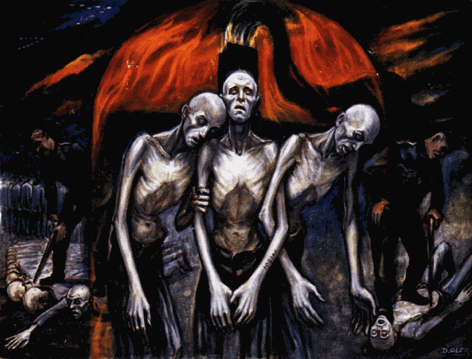
Muselmann (Mussulmen)
In the language of the concentration camps, "Muselmann" (plural: Muselmänner or Mussulmen) was a term used to describe prisoners suffering from extreme emaciation and exhaustion. These individuals were essentially "walking skeletons" who had lost the will to live and had become unresponsive to their surroundings.
The origin of the term is debated, but it is generally thought to refer to the way these prisoners would crouch or rock on the ground—which some observers thought resembled the position of Muslims (Muselmänner) in prayer. In the brutal hierarchy of the camps, becoming a Muselmann was often the final stage before death or selection for the gas chambers.
Post-War Struggle: The Hidden Children
After the war, the Jewish community faced a heartbreaking struggle to reclaim thousands of children who had been placed in Christian institutions, such as convents and private homes, to save them from Nazi persecution. While these families and institutions had provided a sanctuary that saved the children’s lives, many were reluctant to return them to their surviving relatives or the Jewish community. It took years of complex legal battles and significant financial costs to reunite these children with their heritage and people.
International Holocaust Remembrance Day
International Holocaust Remembrance Day is observed annually on 27 January. This date marks the anniversary of the liberation of Auschwitz-Birkenau by the Red Army in 1945. It serves as a Global Day of Commemoration to honour the six million Jewish victims of the Holocaust and the millions of others who suffered under Nazi tyranny.
The Swastika: A Stolen Symbol
The word "Swastika" is derived from the Sanskrit svastika, which translates to "good fortune" or "well-being." For thousands of years, it has been—and remains—a sacred symbol of peace and prosperity in Hinduism, Jainism, and Buddhism.
However, in the 20th century, the symbol was appropriated by Adolf Hitler and the Nazi Party to represent "Aryan" supremacy. Today, in the Western world, it is primarily viewed as a symbol of hate, genocide, and division. Understanding its history is vital to distinguishing between its ancient, peaceful origins and its modern use by extremist groups.
Aktion Reinhardt and the Heydrich Legacy
The Deadliest Phase: Aktion Reinhardt"
Aktion Reinhardt" (Operation Reinhard) was the codename for the systematic plan to murder the Jewish population within the General Government—the region of occupied Poland not directly annexed by the German Reich. This operation saw the construction of three notorious death camps: Bełżec, Sobibór, and Treblinka. Most historians agree the operation was named in honour of Reinhard Heydrich, the "Architect of the Holocaust," following his assassination by Czechoslovak resistance agents in Prague in June 1942.
The Younger Brother’s Resistance: Heinz Heydrich
In a stark contrast to his brother's legacy, Heinz Siegfried Heydrich took a different path during the war's final years. An SS Obersturmführer and journalist for the military newspaper Die Panzerfaust, Heinz's perspective changed dramatically after Reinhard's death. Legend suggests that after receiving a collection of his brother's personal files, Heinz was so horrified by the enormity of the "Final Solution" that he began using his position to help Jewish friends and others escape.
Between 1943 and 1944, Heinz used his access to military printing presses to supply at least several individuals with forged exit visas and identity documents. In November 1944, fearing that a routine economic investigation into his newspaper's paper supplies was actually a Gestapo probe into his illegal activities, Heinz committed suicide to protect his wife and children from retribution
Bishop Ludwig Müller (1883 – 1945) The "Reich Bishop"
Ludwig Müller was a staunch Nazi supporter and the leader of the "German Christians," a movement that sought to align Protestantism with Hitler’s racial ideology. Müller’s primary goal was to "de-Judaize" the Bible, which involved removing the Old Testament and erasing the Jewish context of the New Testament.
Müller faced a fundamental, logical wall: he could not explain how to separate Jesus from his Jewishness. Historically, Jesus was a practicing Jew who lived according to Jewish law. The ultimate irony of Müller’s "Positive Christianity" is that had Jesus lived in Nazi Germany, he would have been classified as an "undesirable," arrested by the Gestapo, and sent to the gas chambers alongside his people.
Jewish Recipients of the Iron Cross
The complexities of wartime alliances occasionally led to surreal historical anomalies. Nowhere was this more evident than on the Finnish-Soviet front, where Jewish soldiers in the Finnish Army fought alongside German troops. Because of their heroism, three Finnish Jews were actually awarded the German Iron Cross—the Third Reich’s prestigious military decoration.
- Leo Skurnik: A Finnish doctor who organised the evacuation of wounded soldiers under heavy Soviet fire. His bravery saved the lives of many men, including members of the Waffen-SS.
- Saloman Klass: A captain in the Finnish Army whose leadership and courage against the Red Army earned him high praise from the German officers serving under his jurisdiction.
- Dina Poljakoff: A Finnish nurse who served on the front lines. Her professionalism and bravery were so respected by her German patients that they recommended her for the award.
The Refusal
In a powerful act of defiance, all three refused the honour. Skurnik and Klass reportedly requested that their names be removed from the list of recipients. Poljakoff attended the ceremony to confirm that she had indeed been nominated, but walked away before the medal could be presented. These individuals chose to honour their heritage and their conscience over a decoration from a regime that viewed them as "subhuman.”
Stolpersteine: Stumbling Stones of Memory
To ensure the victims of the Holocaust are never forgotten, the German artist Gunter Demnig launched the Stolperstein project in 1992. These "stumbling stones" are small, concrete cubes topped with a brass plate, placed into the pavement in front of the last known residence of a victim before they were arrested or deported.
Each brass plate is hand-engraved with the victim's name, their date of birth, and their ultimate fate—whether they were murdered in a camp or died in exile. Demnig’s philosophy is that "a person is only forgotten when their name is forgotten." By placing these memorials in the paths of our daily lives, we are forced to "stumble" over the memory of those who were once our neighbours.
Today, with over 100,000 stones laid across Europe, the Stolperstein project is the world's largest decentralized memorial. It serves as a permanent, quiet reminder of the millions of lives cut short and a vow that their names will never be erased from history.
17043